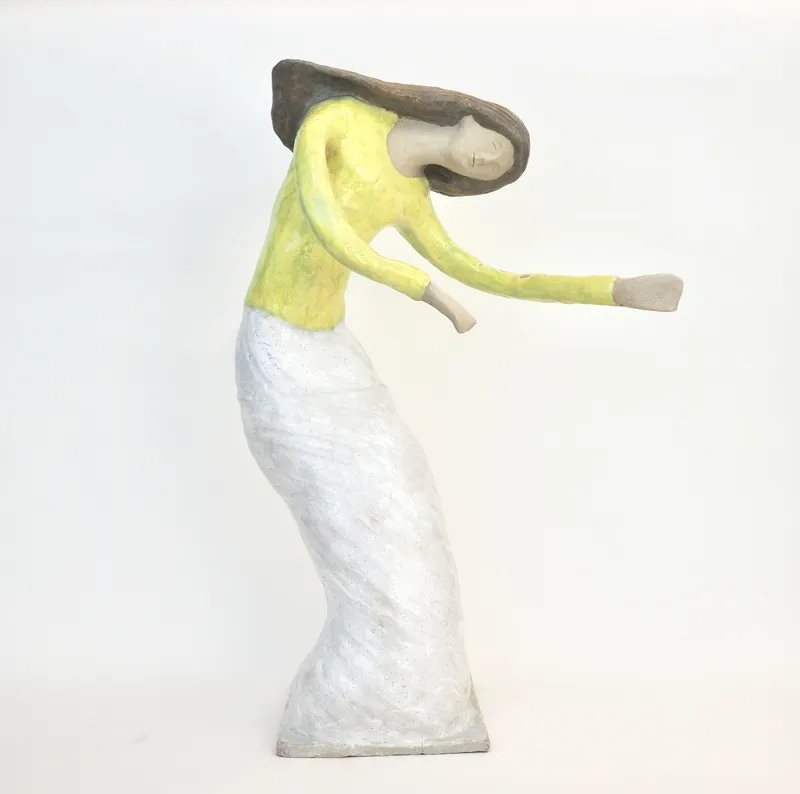
Gavin Chai and Rupert Travis present works which unfold in the space between reality, memory and collective imagination. Their practices draw us into suspended moments, where form, memory, and material converge - offering reflection on inner worlds and shifting realities. At its core, this duel presentation examines the instability of the image. Across their respective practices, Chai and Travis resist narrative closure, instead proposing works that operate as open fields of association.
Gavin Chai
Gavin Chai's works are introspective provocations, which explore themes of alienation, belonging and home. They often contain a repertoire of invented characters, settings and motifs, which hint at broader narratives and histories. His work connects with the artistic traditions of the European Northern Renaissance, Flemish Primitives and Ancient China - yet they are dreamlike and frequently contain both disparate and overlapping forms, which resist fixed interpretation.
Central to Chai's practice is an ongoing commitment to learning. His research projects span art history, music, Russian literature and classical Chinese philosophy. as well as an interest material aspects traditional painting techniques. This intellectual and material curiosity informs the both the conceptual foundation and technical precision of his work. More recently, Chai has turned his hand to ceramics, bringing these sensibilities to the human form in three dimensions, and how it activates negative space. His latest series, Tao Yong (陶俑), draws on the tradition of Chinese tomb figures from the Tang Dynasty (618 - 906 CE), which often portrayed attendants such as officials, dancers, and musicians in animated poses. Historically, these figures were created to serve the deceased in the afterlife, embodying both function and belief.
Chai's elegant ceramic figures echo the formal qualities of this tradition while reinterpreting it through a contemporary lens. Elongated, poised, and quietly expressive, they reflect the artist's own contemplative nature and speak to the richness of an individual's inner world, where contentment, creativity and resilience flourish independently of external validation. Many of the works are deliberately fired to the brink of structural collapse before being glazed and re-fired at a lower temperature. This process becomes a conceptual extension of the figures themselves-their curved, near-faltering postures mirroring a state of tension between fragility and endurance.
In this way, Chai's practice offers a poetic reflection on the human condition and the impact of the modern world on individuals.
Rupert Travis
Rupert Travis is a New Zealand-born artist based in Ōtautahi Christchurch. His practice explores the intersections between medium, materiality, and subject matter, drawing on fragments of memory and image to reconfigure everyday scenes into lyrical, dreamlike compositions. Through the interplay between implied narrative and the physical application of paint, his works occupy a space between illusion and surface-balancing what is depicted with the inherent flatness of the canvas.
By removing clear markers of time, place, and identity, Travis creates compositions that resist fixed interpretation. Instead, emphasis is placed on the painting as an object, and on the relationships between its figurative elements, gestures, and material presence. This process of reduction extends into his handling of surface, colour, and composition. As such, his work retain a sense of immediacy, drawing the viewer close to the act of mark-making itself. There is an openness to them-a raw, unresolved quality-that invites multiple readings and encourages personal interpretation.
This new series see's Travis extends his sustained interest in painting as a physical object - drawing on a lineage in which the edges and sides of the support have been treated as active pictorial space rather than concealed margins. From the collapse of illusionistic depth in late modernist painting to more recent material-driven practices, artists have increasingly emphasized the literal structure of the canvas or support, allowing paint to spill over, wrap around, or remain visibly unfinished. This is perhaps exemplified in Travis' painting "study of three ships" rendered on a recycled coffee sack, which still bears traces of its original branding on the reverse. This vestige of former use on the substrate - along with the visible marks and residues of the painting process - locate the work within this history, foregrounding process, materiality and the objecthood of the painting itself. In this way, the works gesture beyond their frames, prompting the question of whether we are witnessing a complete scene, or only a fragments of unfolding and ongoing narratives.


