Harry McAlpine

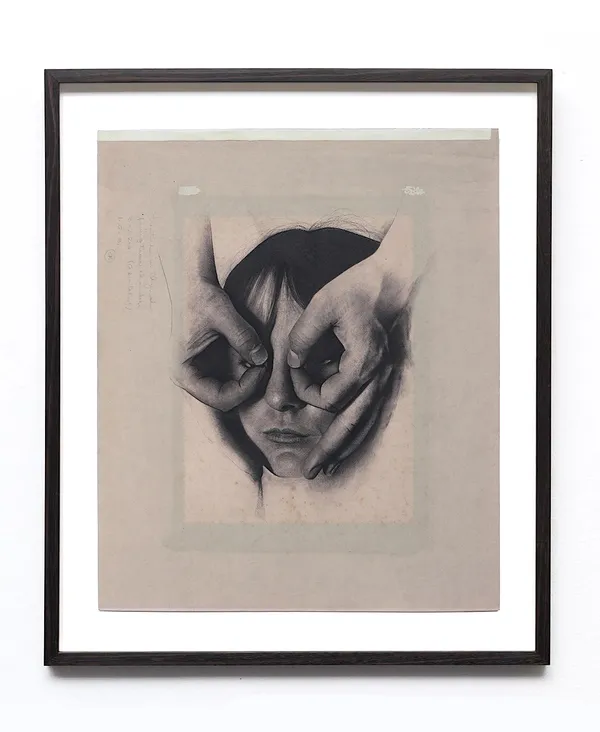
Mcalpine’s recent practice contains two overlapping dialogues. One is an outward-facing exploration of contemporary themes - particularly our evolving relationship with technology and the conditions of the present moment. The other, more private philosophical concerns, about the nature of art-making and how meaning is constructed in an ‘absurd universe’. Influenced by Camus and his notion of ‘Absurdism’, McAlpine views meaning not as an intrinsic property of the world but as something humans must actively create and project. On this view, the act of making becomes a defiant necessary gesture - an attempt to “give the void its colors.” (1). In recent works, the artist has investigated how time, labour and craft can ‘charge’ (imbue?) material objects with meaning. This stands in contrast to the accelerated production of contemporary society, which prioritises efficiency and profit over depth and care, leaving the world populated with objects that feel hollow or “negatively charged.” In this respect, the artist’s builds on Benjamin’s notion of the lost aura (2) - the singular ‘authentic presence’ imbued within an artwork, via the hand of the artist. In the digital age, this loss is amplified by the endless circulation/algorithm of digital images/content, where meaning and material are flattened/collapsed into an endless ‘virtual space’ which has limited power to have traction with/shape/inform the material world.
Drawing on Brian Eno’s idea that artists “create worlds they want to exist in” the Mcalpine considers his practice as an act of world-building - one that extends the collective imagination and contributes to the evolving fabric of culture. From the invention of the perfect sphere to the creation of digital realms, art has always expanded the boundaries of human possibility. Today, however, Mcalpine observes that the imaginative space once occupied by art is increasingly subsumed by virtual environments governed by algorithms and profit motives. In response, Mcalpine’s new work advocates for a return to the tangible and the crafted; for process over product, material engagement over digital consumption, with the slow, deliberate act making of meaning in a world that too often forgets its value.
(1). Albert Camus, The Myth of Sisyphus
(2). Walter Benjamin art in the age of mechanical reproduction
-
 Frankenstein #4 Sold
 -
Perhaps the First Ever Human-made Sphere Was Made Of Dirt, And Was Made For No Particular Reason, 2026 Sold
-
Study On Found Card.., 2026 Sold
-
I Like Technology and Technology Likes Me* Sold
-
To Pluck A Thorn, Place It On One's Nose and Become A Rhinoceros, 2026